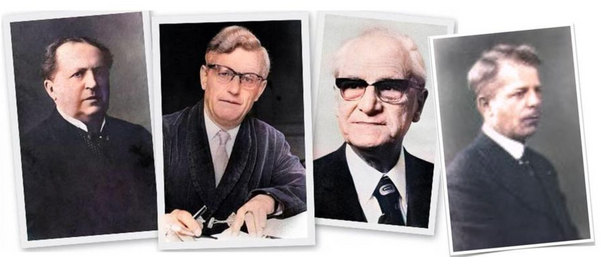
Reformational philosophy: an introduction
The idea of the multifaceted-ness of reality is to be found in the thought and writings of the Dutch lawyer and philosopher Herman Dooyeweerd (1894-1977). Dooyeweerd was one of the major architects of what is known as Reformational philosophy [wikipedia link]; it has also been called the cosmonomic idea - a translation of the Dutch de Wijsbegerte der Wetsidee [WdW] - and the
Dooyeweerd [wikipedia link]
is one of a number of Dutch Calvinists who were associated with
philosophy. The notable others were his brother-in-law Vollenhoven [wikipedia link], H. Van Riessen (b. 1911) [wikipedia link] , J. P. A. Mekkes (1898-1987) [wikipedia link], K. J. Popma (1905-1987) [wikipedia link], the S. African H. G. Stoker (1899-1993) and S. U. Zuidema (1906-1975) [wikipedia link].
The
origins of this philosophy can be traced to ideas first formulated by
van prinster and the one-time Dutch primeminister Kuyper
Guillaume Groen van Prinster (1801-1876)
Van Prinster was an aristocratic Dutchman. He studied at the Calvinistic University of Leyden. He became a Christian in
Abraham Kuyper (1837 1920)
Kuyper is perhaps the best known of those associated with the Reformational perspective. In 1898, B. B. Warfield said of him:
Dr Kuyper is probably the most considerable figure in both political and ecclesiastical
He
took over the leadership of the Anti-Revolutionary party from Van
Prinster and eventually became Prime Minister (1901-5). He founded a
Christian university, The Free University, in
Commenting on this Kuyperian emphasis D. M. Lloyd-Jones, in 1975, wrote:
The Christian is not only to be concerned about personal salvation. It is his duty to have a complete view of life as taught
in the Scriptures ... We must have a world view. All of us who have
ever read Kuyper, and others, have been teaching this for years. (cited
in Rodgers 1992:12).
A full account of Kuyper's life and work, can be found in Vanden Berg's biography (1978) and in McGoldrick (2000).
Dirk Hendrik Theodoor Vollenhoven (1892-1978)
Vollenhoven was Dooyeweerd's brother-in-law. He was a contemporary of Dooyeweerd at the Free University (1911-1914). He studied classics, philosophy and theology. His dissertation in Dutch was on the 'Philosophy of mathematics from a theistic point of view'.
He married Dooyeweerd's sister and became a pastor in the Gereformeerde Kerk in Oostkappelle from 1918. In 1921 he became a pastor in
Dooyeweerd and Vollenhoven's idea of the cosmological principle has provided many important insights in aesthetics, art, economics, education, feminism, football, mathematics, philosophy, technology, social sciences, dogmatics, as well as science. This alone provides ample evidence of the comprehensiveness of this perspective.
It is little known in
The number of technical terms used by Dooyeweerd et al. as well as common terms given specific meanings has added to the opacity of Dooyeweerd's ideas. It
will therefore, be fruitful to outline the contours of the cosmological
perspective. I will attempt to define Dooyeweerdian technical terms as
simply as possible. (A glossary of Dooyeweerdian terms is available here.)
Several
secondary sources are available which provide a useful introduction to
Reformational philosophy and to Dooyeweerd's thought (Spier, Kalsbeek, Kok, Clouser, Steen, Choi). I will draw upon them in the following.
The
two main influences on Dooyeweerd are Dutch neo-Calvinism and
contemporary German philosophy (Wolters 1985). A few observations of
the latter will suffice before outlining the former in more detail.
The main German philosophical influences were neo-Kantianism and phenomenology. Dooyeweerd writes: 'Originally I was strongly under the influence first of Kantian philosophy, later on of Husserl's phenomenology.' (NC I:v) Of
the neo-Kantians Dooyeweerd had 'particular affinities' with Wilhelm
Windelbrand (1848-) and Heinrich Rickert (1863-1936) of the
Another philosopher that influenced Dooyeweerd is Nicholai Hartmann (1882-1950). Hartmann also went through a neo-Kantian and a phenomenological phase. Hartman's
Influence is seen in Dooyeweerd's modal aspects; though Doyeweerd's
work is more developed and sophisticated than Hartman's. Hartman also postulated different ontological levels each of which was irreducible to the previous (Wolters 1985).
The neo-Calvinist influence on Dooyeweerd is more marked.
The contours of Reformational philosophy
Dooyeweerd's main work is the three-volumed New Critique of Theoretical Thought (four
including the extensive index!) The main thesis of the first volume is
that 'an intrinsic connection exists between a philosopher's
theoretical activity and his religious faith' (Freeman 1958: 46). The
subsequent volumes developed a systematic philosophy based on the
Christian 'ground motive' of creation, fall and redemption.
Several
themes dominate Reformational philosophy most of these arise out of the
sovereignty of God, sphere sovereignty and the necessary distinction
between creator and creation. Both of which are neo-Calvinist in origin.
Bernard
Zysla in his introduction in Kalsbeek (1975: 31) writes: 'the most
important premise of this philosophy lies in its assumption that
reality is created by God whose will is the sovereign and redeeming law
for reality'.
The sovereignty of God.
It was Abraham Kuyper who declared: 'There is not a single square inch
of the entire cosmos of which Christ the sovereign Lord of all does not
say, "This is mine".' This sums up the motivation of the Reformational philosophy: to reassert the lordship of Christ in every area of life. God's sovereignty means that he is lord of all including art, history, philosophy, theology, business, politics, mathematics, science, ... .
Sphere sovereignty
Law as the boundary between Creator and creation
A
strong emphasis in Reformational philosophy is the idea of law. Indeed
so strong that in Dutch the approach is called the philosophy of the
law idea, or cosmological philosophy.
Dooyeweerd
saw the law as the boundary between God and his creation. God
transcends the law, he does not violate it; he is not subject to his
own laws.
Archimedean points and immanent and transcendent philosophies
Archimedes
placed so much faith in the principle of the lever that he asserted 'give me a place to stand and I will move the world'. This
place is the Archimedean point. All philosophies need an 'Archimedean
point', a point of reference from which to base its ultimate support. Two classes of philosophy can be distinguished: the immanent and the transcendent. Immanent
philosophies place their Archimedean point within philosophy/ creation;
transcendent philosophies place it outside philosophy/ creation.
An example may help clarify the distinction. Immanent
philosophers include Descartes and Kant. Descartes' starting point was
thought, and Kant's reason. Reformational philosophy is a transcendent
philosophy, its Archimedean point is Christ, who is the source and
sustainer of all things.
Immanent philosophies are inherently reductionistic and pagan; i.e. they deify an aspect of creation by making it self-existent.
Linked to the Archimedean point are religious ground motives.
Religious ground motives
Dooyeweerd
identified four 'religious ground motives' that have shaped the
development of western culture. These were form/ matter; grace/ nature;
freedom/ nature and creation, fall and redemption. The first three are
'internally dualistic and fragmentary', the latter biblical. A useful historical overview of, these ground motives is found in Dooyeweerd (1979).
Figure 1. (c) Richard Russell.
Dooyeweerd comments: 'The development of western culture has been controlled by several religious ground motives. These
motives acquired their central influence upon the historical
development of mankind via certain cultural powers, which over the
centuries, successively gained leadership in the historical process.
The most important of these powers have been the spirit of ancient
civilisation (
Three basic differences
For
Dooyeweerd all things are subjected to God's law and to God. All things
include: the heavenly, i.e. angels ‑ both good and evil; and the
earthly. Within the earthly are a diversity of kingdoms, domains or
realms: humans, animals, plants and non-living things (human, animal,
vegetable and mineral (Hart 1981:268 ff)); within these kingdoms are
different kinds.
Within these kinds are three basic differences: good and evil, this and that, and modal differences
(i) The good - evil difference.
This is self-evident. Although it is worth mentioning that, this difference does no exist as a virtue of creation. As Wolters (1986:48) notes, sin is an 'alien invasion of creation'
(ii) The this - that difference
The second difference means that this igloo (or whatever) is not that igloo (or whatever). This igloo is different from all other igloos; it has an individuality structure.
(iii) Modal differences
In
an endeavour to describe the unity and diversity of reality Dooyeweerd
identified fifteen different modal aspects or law spheres. Each thing
that exists is subjected to God in each of these modal aspects.
Modal aspects
Each
of the modal aspects has certain laws or norms associated with them. In
order of increasing complexity these modal aspects are: number, space,
kinematic, physical, biotic, sensitive, analytical, cultural,
linguistic, social, economic, aesthetic, juridical, ethical and faith.
All of these dimensions are present in reality and none can be reduced
to another, i.e. they are irreducible.
Figure 2 E L Hebden Taylor

Clouser
notes that these modal aspects were arrived at by taking every
large-scale kind of properties and laws which has been distinguished in
the history of philosophy and science (1991:205).
They are not arbitrary. The order of them is also significant. The
higher modes presuppose the lower. For example, the economic mode
presupposes a social and a lingual mode. Without the social mode what
point an economic, and without a lingual how could economic values be
communicated? This is not to suggest that the higher modes are more
important or that the lower modes are more basic. Each mode equally
depends on God.
Stafleu (1987) In discussing theories shows how the Pythagoreans, Plato, Descartes and Galileo, and
Each modal aspect - among other things - has the following:
These
modal aspects or law spheres provide, among other things, an excellent
tool to avoid reductionism and to identify idolatries.
Each
thing has one aspect that is so important that it characterises it,
this is called its leading function. The bar in table 1 represents this
leading function. The leading function of humans is faith; for animals,
sensitive; for plants, biotic; for rocks physical. (This is obviously a
broad classification; some Dooyeweerdians suggest that animals may
function at higher modes (e.g. Hart 1984:181), another (Zysla 1981)
suggests that some single-celled cannot be classed as animals or plants.
Subject and object
A distinction is made between subject and object. Every thing has a leading function, or a qualifying aspect. In modes higher than its leading function (sometimes called its superstratum) it has an object
function (indicated by the full line in table 1). For all aspects lower
than its leading function (sometimes called the substratum) it has a subject function (indicated by the broken line).
For
a tree, its leading function, or qualifying aspect, is biotic. Hence,
for aspects lower than the biotic (i.e. numerical, spatial, kinematic
and physical) it has a subject function, it functions 'actively': it
has a size which can be measured, it takes up an amount of space, it
sways in the breeze, it has certain physical properties, it is a living
thing. In the higher modes, it has an object function, it
functions 'passively': it can have certain things done to it, but it of
itself cannot do them. Its size, type and
colour
can be perceived, but it cannot perceive itself (sensitive); it cannot
name itself but it can be named (lingual); it cannot think, but it can
be thought about (analytical); it has a certain economic value but it
cannot engage in economics (economic); it can be possessed but it
cannot possess (juridical); and so on.
Hence, all things have either a subject or an object function in all modal aspects. Humans alone function actively as subjects in all modal aspects.
An
axe is subject to the law of gravity; so is man. But humanity's
humanness is more apparent in their being subject to moral, analytical
or juridical norms. Think of the roles and
responsibilities of man and an axe in a court session. The axe lies on
the table as an exhibit in a, murder case. The defendant has violated moral and juridical norms, but the axe has not. Still, the axe plays a role in these normative aspects; it is not important in the hearing as legal evidence. Its
role is that of an object function in the moral and juridical aspects;
its subject function ends with the physical (Kalsbeek 1975:122).
Uko Zysla, of
The
cell is the minimal unit capable of independent life. As such it is
generally recognized to be the unit structure and function of life. In
contrast to molecules, we can refer to a cell as being alive. This is
possible because we recognize that the cell functions in a biotic
(vital) way. A cell functions in the numerical, spatial and
physico-chemical [kinematic and physical] aspects of being. The numerical aspects are apparent in the particular ratio of cell surface to cell volume of each type. If
this ratio becomes too small due to increase in volume, the transport
of materials across the membrane could limit and thus hinder the
functioning of the cell. The cell also possesses a
physico-chemical aspect which is evident in the metabolic processes, in
which the energy, requirements for the various reactions involved are
determined by physico-chemical laws. Furthermore, the colloidal nature
of the cytoplasm, is really a physico- chemical function of the
cytoplasm even though extremely important for the vital activities of
the cell. (Zysla 1977: ch 14).
We can apply the fifteen modal aspects to natural science. Natural science is concerned with the numerical, spatial, kinematic, physical and biotic modes; these are the fields of its investigation.
Sensitive The impressions received from sense data, and psychological factors are obviously important considerations for the scientist.
Analytical Analysis is a vital part of science; it is needed to distinguish between competing theories and hypotheses.
Cultural/ historical Science is performed in a particular cultural milieu and context; it cannot be divorced from it.
Lingual
Science has its own symbolism: e.g. Mg, MgO. The results of
investigations have to be communicated through specialist journals or
conferences. The language of which are often unintelligible to a
non-expert in the specific field.
Social
Kuhn, has shown how important the community of scientists is to the
advancement or otherwise. Similarly, Polanyi talks about a community of
explorers.
Economic
The restraints of funding means that scientists have to choose their
research carefully to have a chance of securing funding: no money, no
science.
Aesthetic The beauty and simplicity of. a theory is one criterion for its validity.
Juridicial Scientists have a legal responsibility, they should not break the law no matter how important their research.
Ethical
As well as legal standards there are certain moral and criteria that
have to be adhered to. Should animals be used in research, should
untested
genetically engineered organisms be released in to the
environment, should we clone humans? These are all ethical issues that confront the scientist.
Faith Polanyi (as well as Dooyeweerd) has shown how important faith is to science.
Objections
Despite the fruitfullness, the comprehensiveness and the consistency of this approach it is not withouit its detractors. One criticism is its lack of wide of acceptance. This is hardly a valid objection: democracy is hardly an arbiter of truth. Reasons for its lack of popularity have in the
A strait-jacket imposed on reality?
As
mentioned earlier Dillier (1990) raised a number of objections. Not
least, he accuses the fifteen modal spheres of being a strait-jacket
imposed on reality. Whereas, the modal spheres have arisen out of reality. The
fact that there is fifteen of them is not written on tablets of stone;
indeed many Dooyeweerdians argue over the number of them and the
position of them (see table 2).
Table 2. A comparison of the list of modalities by Dooyeweerd, Clouser and Roper
|
|
DOOYEWEERD |
CLOUSER |
ROPER |
|
1 |
Arithmetical |
Quantitative |
Numerical |
|
2 |
Spatial |
Spatial |
Spatial |
|
3 |
Kinematic |
Kinematic |
Kinematic |
|
4 |
Physical |
Physical |
Physical |
|
5 |
Biotic |
Biotic |
Biotic |
|
6 |
Psychical |
Sensory |
Percipient |
|
|
|
|
Affetcive |
|
7 |
Analytical |
Logical |
Aesthetic |
|
8 |
Historical |
Historical |
Logical |
|
9 |
Lingal |
Linguistic |
Technico-cultural |
|
10 |
Social |
Social |
lingual |
|
11 |
Economic |
Economic |
Social intercourse |
|
12 |
Aesthetic |
Aesthetical |
Economic |
|
13 |
Juridicial |
Justitial |
Jural |
|
14 |
Ethical |
Ethical |
Ethical |
|
15 |
Faith (pistical) |
Fiduciary |
Confessional |
Olthius (1969) changes the ethical mode to troth, or human faithfulness. Ethics
he points out is the discipline that determines 'goodness'; and to be
'economically good' is very different from 'aesthetic goodness'. Many
dislike the term 'historical' and have suggested 'historical-cultural',
techno-formative and techno-cultural. Clouser prefers
not to use nouns to describe the modes: 'nouns' tend to encourage the
misunderstanding that these are classes or groups of things' (Clouser
1991: 205).
Fowler
(1991) in discussions with W.J. Ouveneel (1985) suggests that the
sensitive or psychic mode should be replaced by two distinct and
irreducible modes of functioning: 'percipient', characterised by the
meaning kernel of 'sense perception'; and the 'affective' mode,
characterised by 'emotional feeling'.
Duncan
Roper has also revised the order of the list he places the aesthetic
mode is placed earlier than the logical. Fowler (1991: 221) agrees with
Roper in moving the aesthetic, as he feels aesthetics is not dependent
on cultural formation; he prefers to place it between the logical and
historical/ cultural.
So
rather being a strait‑jacket the modes are open to adjustment in the
light of observations and insights from reality; they are a response to
the experience of reality.
Christian philosophy?
Dillier's
other objections arise primarily over the question of the relationship
between philosophy and Christianity. Dillier denies that there is a
distinctively Christian approach: 'I tend to side with those people
[Including Heidegger and Barth] who deny the possibility of Christian
philosophy' (1990:140). The Reformational view affirms the existence of
Christian philosophy. And for many commentators there is the rub. A
denial of the existence of distinctively Christian philosophy implies
antagonism to the Reformational philosophy as it claims to be a
Christian philosophy.
Two
important questions must then be addressed and answered affirmatively
if the Reformational perspective is not to flounder: (i) is a
distinctively Christian philosophy possible? and (ii) is the
Reformational perspective distinctively Christian?
Is a distinctively Christian philosophy possible?
Most
contemporary philosophers of science are in agreement that neutrality
and objectivity is a fallacy. Our perception of reality is coloured by
our worldview. Facts are theory dependent; and theories are worldview
dependent.
If
Christianity is a worldview, then as with any worldview, it determines
the shape and framework of theories and consequently facts. It must
then mean that a. distinctively Christian approach to, science and the
philosophy of science is feasible.
Is the Reformational perspective distinctively Christian?
Could
not a non-Christian accept the main contours of the Reformational
approach? If so it undermines its claim to be distinctively Christian.
I believe the answer to be no. All non-Christians make some or other
aspect of creation (usually one of the modal spheres) self‑existent;
they are therefore at heart reductionistic (and pagan). Modal theory
rejects reductionism. It asserts that no one aspect of creation is the
only genuine aspect or makes the existence of other aspects possible. All creation, each modal aspect, equally depends on God. None is reducible to another (see further Clouser 1991: ch 10)
To
accept a Reformational perspective one needs to accept the biblical
distinction between the creator and creation. Everything other than God
is creation. Nothing in creation is therefore self‑existent; to declare
it to be so implies that something is uncreated, which gives it the
status of divinity. The Reformational approach therefore comports well
with Christian presuppositions.
A Reformational approach is then at least prima facle
a Christian approach. It should be stressed however that it is a
Christian approach and not the Christian approach. Other perspectives
may be equally Christian. To accept a plurality of Christian approaches
does not deny the validity of any one.
References
Roy Clouser A sketch of Dooyeweerd's philosophy of science. In Facets of Faith and Science. pp.81-97
Roy Clouser 1995. The impact of Dooyeweerd's philosophy on the natural sciences: whence the difference? In Christian Philosophy at the Close of the 20th Century. Ed Griffoen & Balk. Kampen Kok.
Antoni Diller. Herman Dooyeweerd - a profile of his thought. Spectrum 22:2 Summer 1990. pp. 138- 154.
R. D. Henderson Iluminating Law VU, 1994
L Kalsbeek Contours of a Christian Philosophy: An Introduction to Herman Dooyeweerd's Thought. Wedge:
John Kok Patterns of the
Bernard Zysla 'Introduction' in Kalsbeek
C T McIntire (ed) The Legacy of Herman Dooyeweerd
Mark Roques and Jim Tickner Fields of God Authentic, 2003
Richard Russell In defence of Dooyeweerd and of Christian philosophy Spectrum 23:2 Summer 1991. Pages 147-159.
Calvin Seerveld
Egbert Schuurman
Gordon Spykman
Alan Storkey
Elaine Storkey
Peter Steen The Structure of Dooyeweerd's Thought. Wedge:
D. F. M. Strauss and Michelle Botting (eds) Contemporary Reflections on the Philosophy of Herman Dooyeweerd Edwin Mellen:
Brian Walsh and Jon Chaplin. Dooyeweerd's contribution to a Christian philosophical paradigm
S Wolfe A Key to Dooyeweerd. Presbyterian and Reformed:
Al Wolters Creation Regained
Al Wolters 'Intellectual milieu of Herman Dooyeweerd' in C T McIntire